
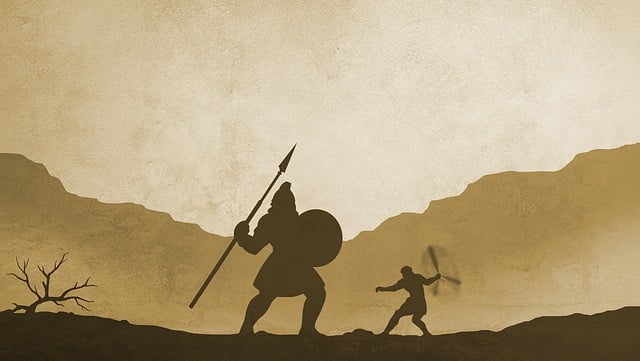
The story of David and his fight with Goliath has reached legendary status. A child with the utmost confidence in God taking on and slewing a giant with a single stone. It is a story we love to tell our children to further their faith in a caring, powerful, and supportive God. But what does Scripture tell us about this little boy. How does it really describe him?
1Sam.16:12 And he sent, and brought him in. Now he was ruddy, and withal of a beautiful countenance, and goodly to look to. And the LORD said, Arise, anoint him: for this is he.
Ruddy – Strongs H132
אַדְמוֹנִי אַדְמֹנִי
‘admônı̂y ‘admônı̂y
ad-mo-nee’, ad-mo-nee’
From H119; reddish (of the hair or the complexion): – red, ruddy.
David was a handsome man with red hair or complexion.
1Sam.17:42 And when the Philistine looked about, and saw David, he disdained him: for he was but a youth, and ruddy, and of a fair countenance.
1Sam. 17:33 And Saul said to David, Thou art not able to go against this Philistine to fight with him: for thou art but a youth, and he a man of war from his youth.
NIV and Amplified Versions of the Bible translate the Hebrew to ‘a young man’. The NASB and ESV also use “youth’ as the KJV does.
Youth, Young man – Strongs H5288
נַעַר
na‛ar
nah’-ar
From H5287; (concretely) a boy (as active), from the age of infancy to adolescence; by implication a servant; also (by interchange of sex), a girl (of similar latitude in age): – babe, boy, child, damsel [from the margin], lad, servant, young (man).
נַעַר nah’ar – designates a male from infancy through early adulthood, emphasizing vitality, teachability, and subordinate status. Context determines whether the focus is on age (“boy,” “youth”) or role (“servant,” “attendant”). The word spans shepherd boys (Genesis 37:2), royal heirs (Genesis 41:12), military aides (1 Samuel 14:1), and priestly disciples (1 Samuel 2:11).
נַעַר gathers nearly every dimension of male youthfulness: promise, vulnerability, service, and participation in God’s unfolding purposes. Scripture’s consistent testimony is that neither age nor social position hinders divine calling; rather, God delights to advance His covenant through teachable, responsive hearts, whether in tents of meeting, royal courts, or shepherd fields.
Before stepping onto the field of battle, David was ushered into the war tent of Saul. (1Sam.17:31)
And David said unto Saul, Thy servant kept his father’s sheep, and there came a lion, and a bear, and took a lamb out of the flock:
And I went out after him, and smote him, and delivered it out of his mouth: and when he arose against me, I caught him by his beard, and smote him, and slew him.
Thy servant slew both the lion and the bear: and this uncircumcised Philistine shall be as one of them, seeing he hath defied the armies of the living God.
And Saul armed David with his armour, and he put an helmet of brass upon his head; also he armed him with a coat of mail.
And David girded his sword upon his armour, and he assayed to go; for he had not proved it. And David said unto Saul, I cannot go with these; for I have not proved them. And David put them off him. (1Samuel 17:34-39)
Saul might not have been brave enough to go out and fight Goliath, but there was nothing wrong with his eyesight. If David was a small boy why would Saul even give him his armor to try on? If we consider the height of Saul:
1Sam.9:2 And he had a son named Saul, a young and handsome one. And there was not a man among the sons of Israel more handsome than he, being taller than any of the people from his shoulder and upward.
Saul was head and neck taller than any other Israelite and he thought that his armor would fit David but David said he had not ’proved’ it. David did not say the armor was too large or heavy. Proving means to be familiar with, or to try out.
Proved – Strongs H5254
נָסָה
nâsâh
naw-saw’
A primitive root; to test; by implication to attempt: – adventure, assay, prove, tempt, try.
1Sam. 17:42 And when the Philistine looked about, and saw David, he disdained him: for he was but a youth, and ruddy, and of a fair countenance.
Looked about – Strongs H5027
נָבַט
nâbaṭ
naw-bat’
A primitive root; to scan, that is, look intently at; by implication to regard with pleasure, favor or care: – (cause to) behold, consider, look (down), regard, have respect, see.
Goliath needed to stare intently at David to see that he was young. If David was a small boy the giant would have not been so intent on identifying his adversary.
1Sam. 17:28 And Eliab his eldest brother heard when he spake unto the men; and Eliab’s anger was kindled against David, and he said, Why camest thou down hither? and with whom hast thou left those few sheep in the wilderness? I know thy pride, and the naughtiness of thine heart; for thou art come down that thou mightest see the battle.
David’s brothers saw his confidence in his own abitlities as arrogance. Bur David’s confidence was not only in himself:
1Sam. 17:45 Then said David to the Philistine, Thou comest to me with a sword, and with a spear, and with a shield: but I come to thee in the name of the LORD of hosts, the God of the armies of Israel, whom thou hast defied.
1Sam. 17:46 This day will the LORD deliver thee into mine hand; and I will smite thee, and take thine head from thee; and I will give the carcases of the host of the Philistines this day unto the fowls of the air, and to the wild beasts of the earth; that all the earth may know that there is a God in Israel.
1Sam. 17:47 And all this assembly shall know that the LORD saveth not with sword and spear: for the battle is the LORD’S, and he will give you into our hands.
To summarize:
David was a tall, strong young man of reddish complexion or with red hair or perhaps even both,, who was supremely confident in the God of Israel and in his own abilities.